The FAL License and Legitimate Property Listings: How to Spot a Trustworthy Ad
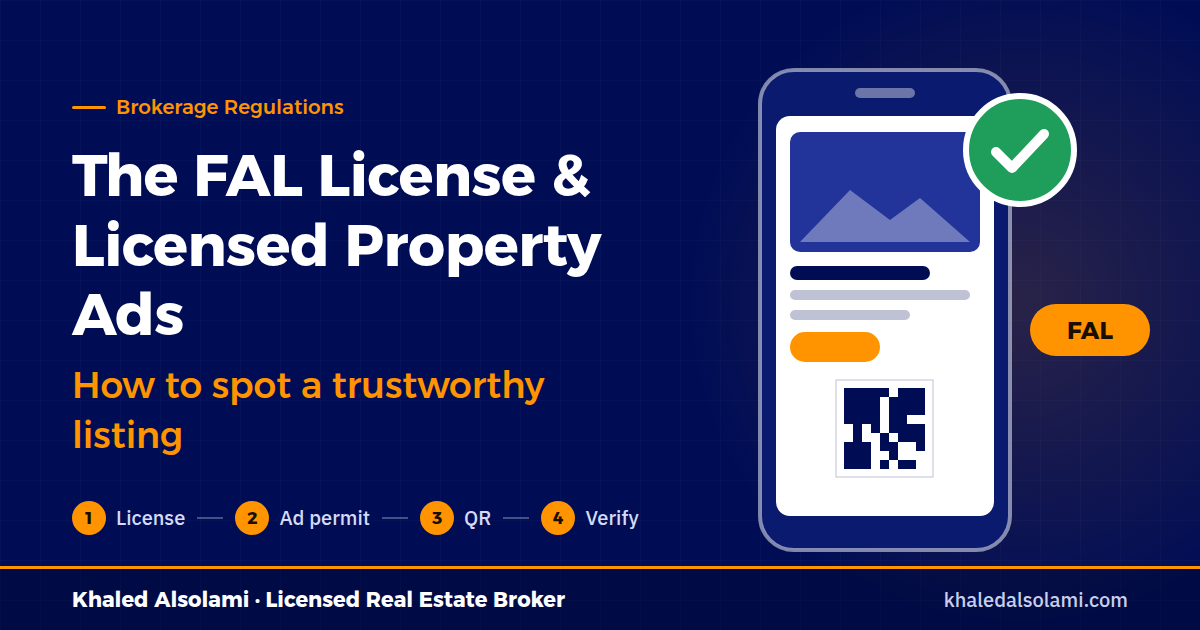
You open a property app or a social media account and see a plot in a prime neighborhood at a price far below market, and the advertiser says "a once-in-a-lifetime opportunity, transfer the deposit today". That is exactly where most real estate scams begin.
The good news is that the Saudi market now has clear tools that let you tell a legitimate listing from a fake one within minutes. In this article, we explain what the FAL license is, what a real estate advertising license is, and how to verify any listing before you pick up the phone.
What Is the FAL License?
FAL is the name of the licenses issued by the Real Estate General Authority (REGA) for practicing real estate brokerage and providing real estate services. The Real Estate Brokerage Law is clear on this point: no one may practice real estate brokerage or provide real estate services without first obtaining a license from the Authority.
Types of FAL License
According to REGA's e-services, FAL licenses include:
- FAL License for Brokerage and Real Estate Marketing: for individuals and establishments. This is the core license for brokers who market properties and act as intermediaries in sales, purchases and leases.
- FAL License for Brokerage and Marketing on Electronic Real Estate Platforms: for platforms and apps that display property listings.
- FAL License for Property Management: for managing a property's financial and administrative affairs on behalf of its owner.
- FAL License for Facility Management: for managing a property's technical and operational aspects on behalf of its owner.
- FAL License for Real Estate Auctions: for organizing real estate auctions in person or online.
- FAL License for Real Estate Consulting.
- FAL License for Real Estate Analytics: for providing real estate analysis and content through the media and social platforms.
Note: Each license covers its own activity only. A broker holding a brokerage and marketing license is licensed for brokerage and marketing, not for any other activity such as property management or consulting. Property valuation is a separate profession altogether, carried out by a certified valuer accredited by the Saudi Authority for Accredited Valuers (Taqeem).
The Real Estate Advertising License: One License per Listing
Many people assume a FAL license is enough for a broker to publish any listing. In reality, there are two different licenses:
- The FAL license: a license for the person or establishment to practice the activity.
- The real estate advertising license: a license for each individual listing of a specific property, issued online through REGA's e-services.
The Implementing Regulations of the Real Estate Brokerage Law require the licensee to obtain a real estate advertising license for every listing. In May 2026, the Umm Al-Qura official gazette published the Regulation on Real Estate Marketing and Advertising, which replaced the previous rules on real estate advertising and on electronic platforms and consolidated the advertising provisions into a single regulation.
Who Can Obtain an Advertising License?
Under the new regulation, the license may be issued to the property owner or to the licensee providing the marketing or advertising service. In the case of a broker, the listing is usually linked to a registered brokerage contract with the owner, which proves the broker is authorized to market that specific property.
What Details Should You See in a Listing?
The Regulation on Real Estate Marketing and Advertising sets out mandatory details for listings, most notably:
- A description of the property, its condition, details and location.
- The type of right being advertised (sale, lease, and so on).
- The services connected to the property.
- Contact details, which must match the registered details.
- The advertiser's name.
- The advertising license number and its expiry date.
- The licensee's license number for the activity.
A listing may instead show just the advertising license number together with a QR code that takes you straight to a page with the full details. This is common in short social media posts and on billboards.
Any listing must be removed immediately once its purpose has been fulfilled or its license has expired, whichever comes first.
What Is Prohibited in a Listing?
- False or misleading information.
- Using the names or logos of government entities without permission.
- Contact details that differ from the registered details.
- A description that does not reflect the property's true condition.
What About Online Platforms?
Real estate platforms have many obligations, including technical integration with REGA's systems, verifying advertisers' identities through Nafath (the national single sign-on), preventing the publication of unlicensed listings and removing them, and providing a mechanism for receiving complaints.
Penalties
The Real Estate Brokerage Law penalizes violators with a warning, suspension of the license for up to one year, revocation of the license, or a fine of up to SAR 200,000. The fine may be doubled if the violation is repeated within three years. Advertising violations are penalized according to the approved schedule of violations in the Implementing Regulations.
How to Verify a Listing Before You Call
Take two minutes and go through these steps:
- Look for the advertising license number or a QR code. Can't find one? That is the first red flag.
- Scan the QR code and check that the details shown match the listing: the location, the area, the property type and the advertiser's name.
- Use the "Real Estate Advertising License Inquiry" service in REGA's e-services. You can check using the advertising license number and see its status: active, expired or cancelled.
- Verify the broker themselves through the "Real Estate Broker Inquiry" service using their FAL license number.
- Match the mobile number in the listing against the advertiser's registered details.
If you come across a listing that is in violation or looks suspicious, you can report it to REGA through its e-services or by calling 199011.
Warning Signs of a Fake Listing
- A price unreasonably below market. Compare it with prices in the neighborhood; the Riyadh land price map can help.
- No advertising license number, or the number does not show up in the inquiry, or its status is expired.
- Urgency and pressure: "Three people are waiting, transfer now."
- A request to transfer a deposit before a viewing or before you have seen the title deed.
- Refusal to give the title deed number or the FAL license number.
- A contact number different from the registered one, or communication by messages only.
- Photos copied from other listings, or generic images that do not actually show the property.
- Use of government logos to create an impression of officialdom.
The golden rule: Do not transfer any money before verifying the listing, the broker and the title deed. By law, the deposit is capped at 5% of the transaction value, and anything above that counts toward the price. More details in our article Real Estate Brokerage: Your Rights and the Broker's Obligations.
Tips for Owners Who Want to Advertise Their Property
- Don't let just anyone publish your property without a registered brokerage contract and an advertising license.
- Watch out for multiple listings of the same property at different prices, as they confuse buyers and hurt your property's price.
- Make sure the listing details are accurate: the area, the frontage, the street width and the land use.
The Bottom Line
A legitimate listing has clear hallmarks: a broker with a FAL license, an active advertising license, complete details or a QR code, and matching contact details. Treat any listing missing one of these with caution.
If you own land or a property in Riyadh and want it marketed under a registered brokerage contract with a licensed listing, send its details through the Market Your Property page. If you are looking for land, send your request through the Find Your Land page.
This article is general information for awareness purposes only and does not constitute legal advice. Laws and regulations may change, so always refer to the official sources: the Real Estate General Authority (REGA) and the Umm Al-Qura official gazette.