Real Estate Investing: How to Build a Successful Property Portfolio Step by Step
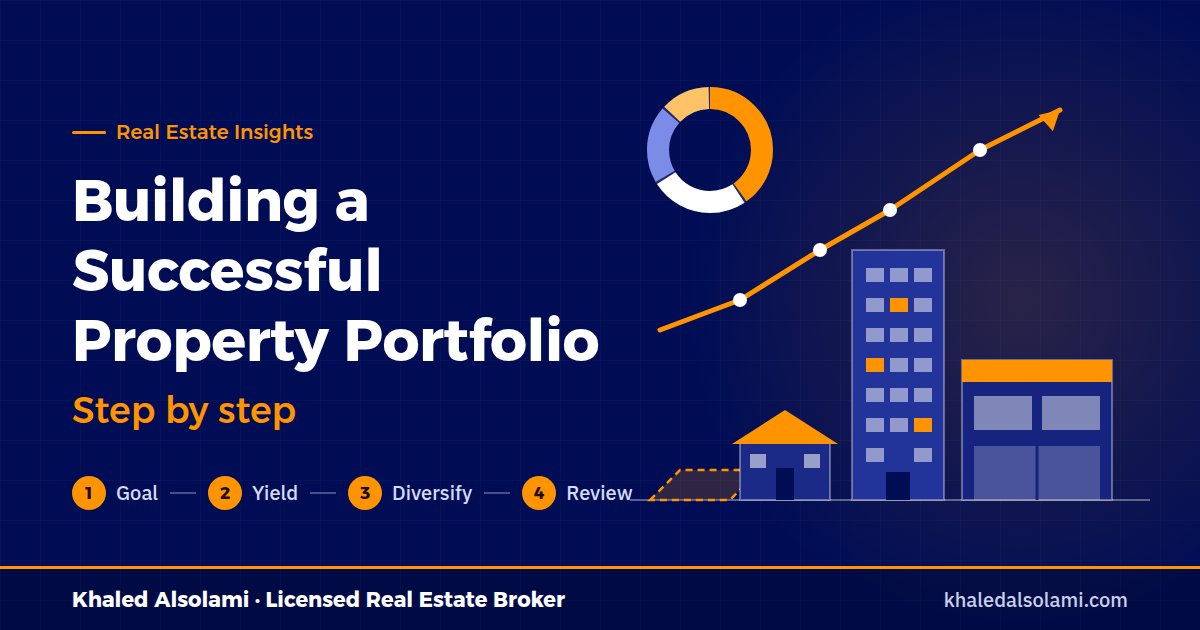
There is a popular Saudi saying that "real estate may fall ill, but it never dies". There is some truth to it, but it does not mean every property is a winner. Real estate is a strong investment if you go in with a plan, and an expensive one if you go in on enthusiasm or because "everyone is buying".
The difference between someone who owns properties and someone who owns a real estate portfolio is the plan: every asset has a role, the numbers are worked out, and the risk is spread.
In this article, we walk you through the fundamentals you need before building your portfolio.
1. Why Real Estate?
Real estate has advantages that make it a core part of many people's wealth:
- A tangible asset you can see and hold the title deed to, not just a number on a screen.
- Regular income from rent, if the property is income-generating.
- Long-term capital growth in locations that are in demand.
- Relative protection against inflation, since land and construction values tend to move with general price levels.
But it also has drawbacks you should be clear about from the start:
- Low liquidity: selling a property takes time. You cannot cash it out in a day the way you can with shares.
- Large upfront capital, plus costs when buying and selling.
- It needs management: tenants, maintenance and rent collection.
2. Define Your Goal Before You Buy Anything
Before asking "What should I buy?", ask "Why am I investing?", because the answer changes which type of property suits you:
- Is your goal a steady monthly income? Income-generating property usually suits you, such as apartments, residential buildings and retail shops. The return is clearer, but growth is slower.
- Is your goal capital growth? Land in growth areas or off-plan sales usually suit you. But there is no income during the waiting period.
- Want to start with a small amount and higher liquidity? Listed real estate investment trusts (REITs) usually suit you, but you do not own the property directly.
Ask yourself as well:
- How long is your investment horizon? Two years is very different from ten.
- Will you need this money soon? If so, direct property may not be the best fit for it.
- How much risk can you tolerate? Bank financing magnifies both profits and losses at the same time.
3. Get to Know the Real Estate Investment Options
1. Rented Residential Property
An apartment, a floor or a building that you lease out. This is the most common type, and its income is clear. Residential lease contracts must be documented on the Ejar platform, which protects your rights as a landlord and makes rent collection easier.
2. Commercial Property
Shops, offices and warehouses. Returns are often higher than residential, but vacancy periods can be longer, and this type is more sensitive to economic conditions and the strength of the commercial location.
3. Land
Land needs no maintenance and no tenants, and the bet is on capital appreciation. But it produces no income while you wait, and in Riyadh you need to keep white land fees in mind: the amended law imposes annual fees of up to 10% of the land's value on undeveloped land within the designated zones, where the area, or the total land held by the owner within the zone, is 5,000 m² or more.
4. Off-Plan Sales
You buy a unit before its construction is complete, usually at a lower price than a ready-built one. This activity is regulated and licensed by the Real Estate General Authority (REGA), and buyers' funds are deposited in an escrow account. Always make sure the project is licensed before making any payment, and understand the delivery and payment schedule.
5. Listed Real Estate Investment Trusts (REITs)
You buy units in a fund that owns income-generating properties and trade them on the stock market like shares. Among their key regulatory requirements:
- The fund must distribute at least 90% of its net profits annually.
- At least 75% of its assets must be in developed, income-generating real estate.
Their advantage is that you can get in with a small amount and sell easily, but the unit price fluctuates with the market, and you have no say in how the properties are managed.
4. Calculate the True Return, Not the Advertised One
The most misunderstood figure in real estate investing is the return. Let's look at an example:
A building is offered for SAR 1 million with annual rent of SAR 60,000.
Gross yield = annual rent ÷ price = 60,000 ÷ 1,000,000 = 6%
This is the figure that is usually advertised. But in reality:
Purchase costs:
- Real Estate Transaction Tax (RETT) at 5% = SAR 50,000 (if you agreed to bear it)
- Brokerage commission (sa'i) at 2.5% = SAR 25,000
- Actual cost = SAR 1,075,000
Annual expenses (estimated):
- Maintenance, a few months of vacancy and management = SAR 10,000
- Net income = SAR 50,000
Net yield = 50,000 ÷ 1,075,000 = approximately 4.65%
The gap between 6% and 4.65% is significant over ten years. Always calculate based on the net figure and the full cost.
An important note for Riyadh investors: In September 2025, a decision was issued freezing annual rent increases for residential and commercial properties within Riyadh's urban boundary for five years. It covers both existing and new contracts, with contracts renewing automatically unless either party notifies the other at least 60 days before the end of the term. So if you are buying a rented property in Riyadh, calculate the return on the current rent as it stands, and do not base your decision on an expected rent increase during this period.
5. Diversification Is the Heart of the Portfolio
A successful portfolio does not put all its eggs in one basket. Diversification works across several dimensions:
- Property type: residential, commercial and land.
- Location: different neighborhoods, or different cities, so that your whole portfolio is not affected by a single decision or change in one area.
- Type of return: assets that give you income today, and assets that give you growth tomorrow.
- Liquidity: part in easy-to-sell instruments such as REITs, and part in direct property.
An illustrative example of allocation thinking (not a recommendation): An investor seeking steady income with reasonable growth might build the portfolio around an income-generating asset as its base, then add land in a growth area, and keep a portion in REITs for liquidity. The proportions vary from person to person depending on their goals and circumstances.
6. The Stages of Building a Portfolio
Stage 1: The Foundation
- Get your finances in order and keep an emergency fund separate from your investments.
- Define your goal, your time horizon and how much risk you can tolerate.
- Learn the market: the neighborhoods, the prices and the regulations. You can start with the Riyadh land price map.
Stage 2: The First Asset
- Start with an asset you understand and can manage.
- Don't rush. Your first deal will teach you more than any book.
- Apply every title deed and regulation check before buying; you can refer to How to Buy Land in Riyadh.
Stage 3: Reinvestment
- Don't spend all of your rental income. Set part of it aside to build up toward the next asset.
- This is what allows the portfolio to grow on its own over time.
Stage 4: Diversification and Expansion
- Add an asset of a different type or in a different location.
- If you use bank financing, make sure the income covers the installment with a comfortable margin, even if the property sits vacant for a few months.
Stage 5: Regular Review
- Review your portfolio at least once a year: what net return is each asset delivering?
- For an asset that underperforms over a long period, consider selling it and redirecting its value.
7. Managing Risk
- Liquidity risk: don't put money into real estate that you may need soon.
- Vacancy risk: always assume the property could sit empty for a few months.
- Financing risk: excessive borrowing turns any minor downturn into a crisis.
- Regulatory risk: regulations change, such as rent decisions and white land fees, so always follow the official authorities.
- Concentration risk: one large property is riskier than several mid-sized assets.
Common Mistakes New Investors Make
- Buying on emotion or herd instinct because everyone else is buying.
- Relying on the advertised return without calculating the net figure.
- Forgetting the costs of buying and selling (the tax and the brokerage commission).
- Ignoring new regulations that affect income or costs.
- Investing in unlicensed projects or schemes because the return looks "tempting".
- Failing to diversify and tying all your wealth to a single asset.
- Having no exit plan: when and how will you sell if you need to?
The Bottom Line
A successful real estate portfolio is not built on a single deal. It is built on a clear goal, net numbers, smart diversification, patience and continuous review. Start small, understand every asset you own, and let the income work for you.
If you are looking for land in Riyadh to add to your portfolio, send your request through the Find Your Land page. If you own a property you want to market, you can request marketing for your land.
This article is general information for awareness purposes only and does not constitute an investment recommendation or financial advice. Investment decisions depend on each person's circumstances and goals, and regulations may change, so always refer to the official sources: the Real Estate General Authority (REGA), the Capital Market Authority (CMA), the Ejar platform and the Zakat, Tax and Customs Authority (ZATCA). For an investment decision tailored to your situation, consult a licensed financial advisor.