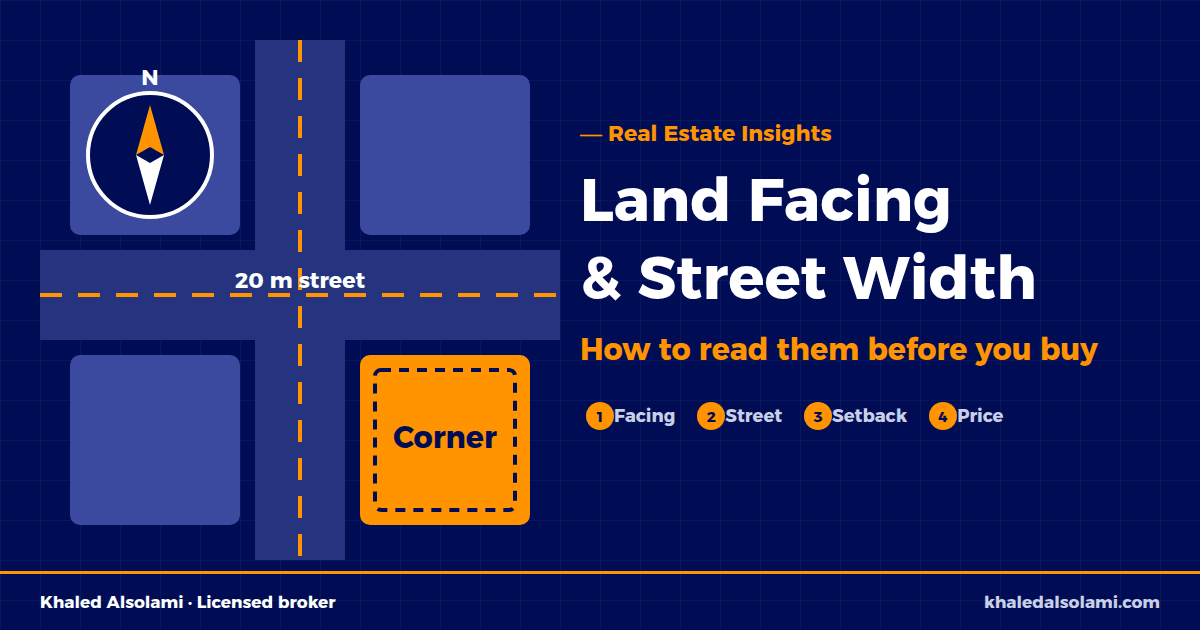
The first two questions an experienced buyer asks about any plot are: "Which way does it face?" and "How wide is the street?" Both shape the house design, the setbacks, how comfortable the home will be, and the price. This guide explains them simply, with numbers from land listings in Riyadh.
1. What does "land facing" mean?
The facing is the side of the plot that borders the street. If the street is on the north side, it is a "north-facing" plot; if it is on the west, it is "west-facing", and so on.
There are eight common cases:
| Case | Meaning |
|---|---|
| North / South / East / West | The plot is on one street on that side |
| North-east, North-west, South-east, South-west | A corner plot on two streets |
| Three or four streets | Streets on three or four sides (usually large plots or blocks) |
How do you confirm the facing?
Don't rely on the ad alone. Check:
- The title deed (sak): it lists the plot's boundaries and lengths on all four sides, and which side borders a street and how wide it is.
- The subdivision plan (kroki): it shows the plot's position, the streets around it and the north direction.
Example from a deed: "West: street 20 m wide, length 35 m" means the plot is west-facing on a 20 m street.
2. Why do buyers prefer some facings?
In Riyadh, preference is mostly about sun and heat:
- North-facing plots are among the most requested, because the front façade and entrance get less direct sun.
- West-facing plots are less preferred by many buyers because of the hot afternoon sun on the façade.
- Corner plots are popular for two frontages, more entrances, and better light and ventilation, but they can mean setbacks on two sides.
These are general market preferences, not fixed rules. Good design can handle most facing drawbacks, and sometimes the price gap is an opportunity.
3. Street width: the common numbers
These widths appear often in Riyadh residential subdivisions:
- 8–12 m: internal side streets.
- 15 m: the typical residential street inside neighborhoods.
- 18–20 m: main residential streets within the neighborhood.
- 25–30 m and wider: main roads, many with commercial uses depending on the subdivision plan.
What street width changes in construction
Under the general requirements for residential villas, the front setback = one fifth of the street width, and not less than 3 m. So:
- On a 10 m street: one fifth is 2 m, but the minimum is 3 m, so the setback is 3 m.
- On a 20 m street: the setback is 4 m.
- On a 30 m street: the setback is 6 m.
Details are in our guide to residential building requirements in Riyadh (Arabic). The subdivision plan itself is always the final reference.
4. In numbers: how much does street width change the price per m²?
We analyzed 1,037 land listings in 75 Riyadh neighborhoods and compared each listing's price with the median of its own neighborhood (to remove the effect of location):
| Street width | Listings | Difference from neighborhood median |
|---|---|---|
| 8–10 m | 38 | about −7% |
| 12 m | 88 | about −6% |
| 15 m | 469 | about −1% |
| 18–20 m | 337 | about 0% |
| 25–30 m | 85 | about +8% |
| 36 m and wider | 20 | about +60% |
How to read the table:
- The gap between residential streets (12 to 20 m) is relatively small in asking prices.
- The big jump comes with very wide streets, largely because many of those plots are commercial or mixed-use, so they differ in permitted use, not just street width. The sample there is small (20 listings).
- These are asking prices from licensed real estate platforms, not transaction prices, and are for comparison and education only.
You can see price by street width for each neighborhood on its page, for example An Narjis.
5. Quick checklist before you buy
- Confirm the facing and street width from the deed and plan, not the ad.
- Work out the front setback from the street width and see how it affects your design.
- For a corner plot, ask about setbacks on both sides.
- A very wide street means easier access, but also more traffic and noise. Decide what suits you.
- Compare the price with plots in the same neighborhood on the same street width, not just the neighborhood average.
- Check the subdivision plan for permitted use, especially on main roads.
Looking for land with a specific facing and street?
The Submit a request page now has fields for facing, street width and number of streets. Choose what you want and I will look for matching listings.
Sources: land listings on licensed real estate platforms and Sakani (our analysis, October 2026), and the general requirements for residential buildings. Figures are for education and comparison, not a property valuation.